Showing posts sorted by relevance for query wearable Art Produced by TextielLab in 2013. Sort by date Show all posts

Saturday, June 27, 2015

Wearable Art Produced by TextielLab in 2013 [1-2]
Wearable Art

Marie-Therese Wisniowski

Preamble
The TextielLab (Tilburg, The Netherlands) is a well established art weaving and knitting institution in Europe. It appeals to students, designers, artists, and architects since it is a one-stop shop experience. It is a well-equipped laboratory and so is home to the latest high-tech weaving looms and 3D-knitting machines. It has a well stocked yarn bank and has in-house expertise so that suitable materials may be custom dyed.

Knitting machine in action at TextielLab.

The TextielLab has previously featured on this blog spot:
Textile Museum in Tilburg (The Netherlands)
TexteilLab & TexteilMuseum (2013)
Wearable Art Produced by TextielLab in 2013


Introduction [1]
Todays post will concentrate on giving a glimpse of TextielLab’s 2013 wearable art output. Stef Miero who has 30 years experience in textiles believes that creativity should rule the design process. He is now a senior product developer at TextielLab specializing in weaving. He believes if you go beyond what software and looms are programed to do, that is when you begin to straddle the edge of creativity. It all comes down to research and experiment, which is not always possible within the mainstream textile industry for production pressure. For Miero the real satisfaction comes from working with designers, some of who have never worked with textiles before, to help them translate their creative vision into fabric.

Stef Miero.


Wearable Art Produced by TextielLab in 2013 [2]
This post will only give a glimpse of five wearable art projects that were completed in the TextielLab in 2013. For a more detailed review please see reference [2].

Name: Virginia Burlina [2]
Title: For Wonder.
Technique: Laser Cutting/Digital Printing.

Flower-decked swimming caps have become icons of 1970s style. Virginia Burlina, a third-year fashion design student at the Royal Academy of Fine Arts in Antwerp, was inspired to expand the look for her whimsical women’s wear collection.

Digital printing in action for Virginia Burlina’s designs.

Design sketch.

Another design sketch.

Hundreds of flowers of different sizes were laser cut from latex sheets and painstakingly washed before being applied to the underlying fabric. Virginia’s aim in adding the 3D floral elements gives the feeling of a “controlled wildness”.

Floral prints and a laser cut layer.

A series of scarfs was also printed with watercolour impressions of topical forests.

A typical look.

The collection was launched at the academy in Antwerp.

Name: KRJST [2]
Title: K2.
Technique: Digital Printing and Weaving.

Sub-culture heroes such as Jim Morrison, Frida Kahlo, Joan Baez, Catholic iconography and male-female antagonism are among the influences drawn on by Krjst, A Brussels-based fashion collective founded in 2012 by Justine Moriamé and Erika Schillebeeckx. In characteristically complex digital prints and weaves, these eclectic influences burst across the fabrics like colors from a prism.

Design sketch of Krjst.

Digital printing Krjst design.

Weaving in progress of Krjst design.

The labour intensity of the production process means collections are kept small, but are updated each season. New collections are often developed with the input of guest collaborators from other disciplines, including graphic designers, illustrators and photographers.

Fashion.

Name: Pauline van Dongen [2]
Title: Hyperspace.
Technique: Knitting.

Pauline van Dongen took advantage of wool’s resilience by creating a pleated fabric as a basis for a sculptural dress.

The designer selecting a yarn.

In addition, she fashioned a top with woolen trimmings made on traditional looms. The trimmings allow the garment to be worn in different ways.

Sculpture knitwear.

This capsule collections features three woollen outfits.

A dress.

One of three outfits.

Name: Fashion Museum. Hasselt Mass Architects [2].
Title: Skyline of Florence.
Technique: Knitting.

The signature stripes of Italian fashion house Missoni are recreated here in the knitted skyline of Florence. This colorful mix of cotton, acrylic, mohair, linen and organic wool provides the backdrop for a special exhibition in tribute to the history of Italian fashion. The bright stripes and scale of the design transform the décor into a work of art in its own right.

Knitted panels.
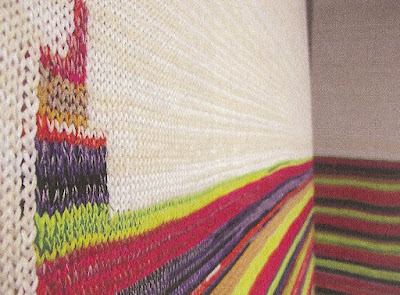
Panel in detail.

It is rare to make use of such large knits, so filling the exhibition space was a challenge. The different panels had to form a seamless fit. The scenography was a joint collaboration between Fashion Museum of Hasselt and MASS Architects.

Exhibition in Hasselt.

Name: Studio Marcel Wanders[2]
Title: Phoebe.
Technique: Knit and Wear.

A 3D-knitted lampshade is one of Studio Marcel Wander’s most recent creations.

Close-up of the knitted mohair spheres.

Made from knitted spheres of mohair, strong monofilaments and elastic, the result is highly tactile, emitting a diffuse light.

Form studies.

The monofilaments add strength, giving the whole a sculptural quality. Much research went into finding materials that were suitable for knitting. The tougher the material, the harder it is to knit.

Transparency test.

The research succeeded and circular knits came rolling off the machine.

Final shape of spheres.

This limited-edition lamp was on show at the TextielMuseum’s “Talking Textiles” exhibition, curated by Lidwij Edelkoort as well as at the Stedelijk.
Museum, Amsterdam.

Video still of soft radiance.

All circular knits aglow.


References:
[1] TextielLab – 100% Innovation.
[2] TextileMuseum and TexteilLab Year Book (2013).

Saturday, June 20, 2015

TextielLab & TextielMuseum – 2013 [1-2]
Resource Review

Marie-Therese Wisniowski

Preamble
For you convenience I have listed below posts on this blogspot that featured Museums and Galleries.
When Rainforests Ruled
Some Textiles@The Powerhouse Museum
Textile Museum in Tilburg (The Netherlands)
Eden Gardens
Maschen (Mesh) Museum@Tailfingen
Museum Lace Factory@Horst(The Netherlands)
Expressing Australia – Art in Parliament House
TextielLab & TextielMuseum – 2013
The Last Exhibition @ Galerie ’t Haentje te Paart
Paste Modernism 4 @ aMBUSH Gallery & The Living Mal
El Anatsui – Five Decades@Carriageworks
The Australian Museum of Clothing and Textiles
Louisiana Museum of Modern Art
Nordiska Museet (The Nordic Museum)
Tarndwarncoort (Tarndie)
Egyptian Museum Cairo - Part I
Egyptian Museum Cairo - Part II
Masterpieces of the Israel Museum


Introduction
The TextielLab (Tilburg, The Netherlands) is a well established art weaving institution in Europe. It occupies a unique niche where expertise, craftsmanship and innovation meld. It appeals to students, designers, artists and architects since it is a one stop shop weaving experience. It is a well-equipped laboratory and so is home to the latest high-tech Lindauer Dornier weaving looms and Stoll 3D-knitting machines. It has a well stock yarn bank and has in-house expertise so that suitable materials may be custom dyed.

DORNIER loom in the TextielLab.

The TextielLab has previously featured on this blog spot – see:
Textile Museum in Tilburg
Wearable Art Produced by TextielLab in 2013


TextielLab & TextielMuseum – 2013 [1-2]
Todays post will concentrate on giving you a glimpse of TextielLab’s 2013 artistic output. However a glimpse of their workflow and workload in 2013 may be of interest to prospective students, artists and clients.

Modern machinery in a heritage building of the TextielLab.

The most difficult stage for students, artists, architects and clients alike, is how to begin to transform an image into an artistic object. Not all images can lead to an effective reproduction in terms of a weaving or knitting process. Some images are far too subtle in terms of color variation that no bank of custom dyed yarns can effectively reproduce. Other images require a resolution (i.e. intricate detail) that is far beyond the capability of even the most sophisticated computerized machinery. Some images have a depth perception that is impossible to duplicate with yarn. Due to the workload constraints of any artistic laboratory, some images are just not interesting enough to waylay more pressing work. Hence any artistic laboratory must have an initial filtering process. If the project submitted contains little interest or is not possible to produce, then the enquiry by a client on submitting an image will be politely declined. However, if the project/image is of interest to the TextielLab and there is a feasibility that the artistic integrity of the image can be preserved as a woven or knitted art object, then the laboratory will move to the second stage – the intake stage – where design and yarn specification will be explored and a cost estimate will be delivered to the client. The next stage is the development stage, where the laboratory will undergo programming of equipment, testing of techniques and selections of yarns to yield the most accurate reproduction as woven or knitted samples. At this point, the client or laboratory may reject going into the production phase since the submitted image cannot be effectively reproduced in this concrete operational rendering of the image. If however it can be effectively reproduced the process will move into the production phase and then into the completion phase.

Workflow procedure of a submitted image by a client to the TextielLab.

The output of the TexteilLab in 2013 in terms of techniques gives an interesting insight the context of its workload. In percentage terms the weaving process was approximately six times more popular than its nearest rivals, namely, knitting, embroidery and digital printing, the latter three hovering around the 9 percentile. The least demanded techniques were laser cutting and tufting that hovered around the third percentile.

Techniques in percentage terms performed by the TextielLab in 2013.

The usage of yarns also reflects the textile outputs with organic cotton (warp and weft) 6308kg in total being used. Wool (Merino) is approximately a sixth of that total with the next three - linen, mohair and acrylic - trailing in the rear.

Usage of yarns in kg in 2013.

The TextielLab not only creates textiles but one of its important functions is that it exhibits some of the textiles it has reproduced from client’s images. Lidewij Edelkoort curated in 2013 - “Talking Textiles’ Exhibition” - at the TextielMuseum together with Philip Fimmano.

Lidewij Edelkoort.

On display were many projects developed at the TextielLab including Kiki van Eijk’s “Townhouse Rug” and Bertjan Pot’s “Pocket Light”. The carpets, curtains, lighting, digital prints and multimedia installations selected for the exhibition reveal that today’s designers are embracing modern lifestyles and moreover, are moving textiles from a merely functional purpose into the realms of wearable art and moreover, into artistic mores.

“Talking Textiles” exhibition in the TextielMuseum.


Vignette of Creative Outputs from TextielLab – 2013 [2]
Only five creative outputs in 2013 from TextielLab will be highlighted below. For a more in depth survey please purchase reference [2].

Kloppenburg and van Egteren
In 1645, Rembrandt van Rijn sat along a bend in the Amstel River to sketch the scene for a small, atmospheric etching. Over 350 years later, the work was hand tufted to a size of 2.5 x 3.5 meters in order to add warmth, color and texture to the offices of Norton Rose Fulbright, a law firm based in Amsterdam’s Rembrandt Tower, near the site that had inspired the Dutch Master. The designers translated the original grey tone etching into a pointillist image incorporating up to six different colors per square centimetre. The image was extremely detailed and took almost a year to tuft.

Title: De Omval
Technique: Hand Tufting.

Close-up of the finished work.

Close up of the painstaking tufting process in action.

Kustaa Saksi
Finnish artist Kustaa Saksi takes jacquard weaving to a new level with “Hypnopompic”; a series of vivid large-scale tapestries employing Jacquard weaving. A hypnopompic state is a dream-like consciousness meandering between waking and sleeping. The artist evokes this with intricate and colourful images of nature’s surreal side in the form of psychedelic spiders, monkeys and insects interwoven with exuberant flora and fauna. The patterns also reflect the visual disturbances that the artist experiences during frequent migraine attacks. A wide range of natural and synthetic materials, from viscose, Lurex and metallic yarns, to alpaca wool and mohair, add extra depth.

Title: “Herbarium of Dreams”.
Technique: Jacquard weaving.

Title: “Grasshoper.”
Technique: Jacquard weaving.

Title: “Arachne’s Web”.
Technique: Jacquard weaving.

Creneau International (Design Studio)
Bar Marie is a new café in the Belgian headquarters of publishing firm Sanoma. Creneau International based its interior concept on magazines, aiming to tell stories, inspire and inform. The café needed a partition for the meeting area; a powerful visual in its own right. The result was a large woven curtain with a classic floral motif symbolising the focus on organic produce. In the fore ground are sketches of food in a contrasting yarn, but from a distance, the sketches form a face. The highly complex design was translated into 24 colors. Color testing help select the right mix.

Color study.

Title: “Café Sanoma Belgium”.
Technique: Jacquard weaving.
Comment: Woven curtain in place at Bar Marie.

The pattern forms a face.

Karin de Waard
The growing interest in corporate social responsibility is manifesting itself in some intriguing ways. Karin de Waard’s “Dstruct” concept is aimed at CSR-committed companies interested in turning their waste into new and potentially viable commercial products. The extension of this concept is “Collection 2”, a room divider and two carpets made from synthetic leather. The room divider’s intricate laser-cut components make optimal use of the material available and any off-cuts used in equally intricate carpets. The highly efficient design can be transferred to other materials such as denim or rubber, and scaled to produce larger or smaller textiles for cushions, bags and clothing.

Title: Dstruct: Collection 2 (Room Divider).
Technique: Laser cutting.

Synthetic carpet.

Assembly of product.

Studio Job
In Miami’s illustrious beachfront is the new Faena Saxony hotel development. No expenses are being spared for this luxurious complex, which encompasses an art center, theatre and luxury housing project in addition to the hotel. Studio Job designed six pennant flags for the hotel entrance. Each custom-embroidered flag features one million stitches. With thousands of stitches available in embroidery software, each stitch was carefully selected based on samples at the TexteilLab. The size of the flag meant that each section had to be embroidered and assembled individually.

Title: Faena Pennant – one complete pennant.
Technique: Embroidery.

One million stitches per flag.


References:
[1] TextielLab – 100% Innovation.
[2] TextielMuseum and TextielLab 2013 Year Book.

Saturday, December 8, 2012

Textile Museum in Tilburg (The Netherlands) [1]
Resource Review

Marie-Therese Wisniowski

Preamble
The TextielLab has previously featured on this blog spot:
Textile Museum in Tilburg (The Netherlands)
TexteilLab & TexteilMuseum (2013)
Wearable Art Produced by TextielLab in 2013
For your convenience I have listed another post on the Textile Museum in Tilburg:
Wearable Art Produced by TextielLab in 2013

I have also listed below posts on this blogspot that featured Museums and Galleries.
When Rainforests Ruled
Some Textiles@The Powerhouse Museum
Textile Museum in Tilburg (The Netherlands)
Eden Gardens
Maschen (Mesh) Museum@Tailfingen
Museum Lace Factory@Horst(The Netherlands)
Expressing Australia – Art in Parliament House
TextielLab & TextielMuseum – 2013
The Last Exhibition @ Galerie ’t Haentje te Paart
Paste Modernism 4 @ aMBUSH Gallery & The Living Mal
El Anatsui – Five Decades@Carriageworks
The Australian Museum of Clothing and Textiles
Louisiana Museum of Modern Art
Nordiska Museet (The Nordic Museum)
Tarndwarncoort (Tarndie)
Egyptian Museum Cairo - Part I
Egyptian Museum Cairo - Part II
Masterpieces of the Israel Museum


Introduction
Tilburg is a landlocked municipality and a city in the Netherlands. It is located in the southern province of Noord-Brabant. Its municipality also includes the villages of Berkel-Enschot and Udenhout. With more than 200,000 inhabitants, it is the second largest city of Noord-Brabant, and the sixth largest city in terms of population size in the Netherlands.

City Center, Tilburg.

Little is known about the early history of Tilburg. Documents from the year 709 A.D. show the name Tilburg for the first time. After that, sources remain silent for some centuries. By the 15th Century, one of the lords of Tilburg, Jan van Haestrecht, built Tilburg Castle. In 1858, however, the castle had to make way for a factory, but its image lives on, in the city’s arms and logo.

Coat of Arms of Tilburg.

Tilburg grew around one of the so-called "herd-places", which were three-cornered plots where a number of sand roads usually met. These herd-places were collective pasturelands for flocks of sheep. Their triangular shape is still reflected in the layout of many places within Tilburg.

Saint Joseph Church In Tilburg, City Center.

The poor farmers - that were living in these hamlets - soon decided to stop selling their wool and rather, to weave it themselves and so for a long time looms occupied a large portion of their houses. By the 17th Century the number of looms in Tilburg exceeded 300. Eventually drapers supplied homes with fleece in order to develop a home cottage industry of weavers. From 1881 the wool industry underwent rapid growth with Tilburg having as many as 145 wool mills. The weaving cottage industry continued until the early years of the 20th Century where woollen textiles from Tilburg became renowned throughout Europe.

King William II (1792–1849) Statue in Tilburg. He always had a soft spot for Tilburg for he once said about the town: "Here I can breathe freely and I feel happy". He supported Tilburg in a financial and practical manner, by improving the sheep breeding and building new farms in the area.

On 15th September 1866, Vincent van Gogh went to the new middle school at the William II college in Tilburg. Constantijn C. Huysmans, a successful artist in Paris, taught van Gogh to draw at the school and advocated to his students a systematic approach to the subject.

Vincent van Gogh’s school photograph (ca. 1866, age 13).

After the Second World War, Tilburg retained its place as the wool capital of the Netherlands, but in the 1960s the industry collapsed and by the 1980s the number of wool mills were few in number. Present-day Tilburg industry is characterized by transport and logistics, due to its geographical location, which enables quick access throughout The Netherlands.


Textile Museum in Tilburg (The Netherlands) [1]
The textile museum in Tilburg was established in 1958. The original premise was a former 19th century complex of the former Mommers & Co woollen fabric factory (that operated as a textile mill). It was listed as a national monument in 1986 and was recently merged with the Tilburg Regional Archives. In 2008 it was renamed as the Audax Textile Museum of Tilburg. Its collection is divided into four sections: textile science, design, industrial culture and arts.

Old Building Complex of the Audax Textile Museum of Tilburg.

The previous functions and buildings were not coherent (due to their history) and so were fragmented in design and purpose. Consequently, a new unifying structure had to be designed and built in order to provide an exciting entrance into the building complexes that would not only house a coffee shop, retail store, historical textile machines (e.g. wooden looms etc.), valuable archives with corresponding reading rooms as well as modern and functional machinery (from knitting machines to a laser laboratory) that needed to be at the cutting edge of transforming artist’s designs into textile reality.

Glass Entrance to the Audax Textile Museum Tilburg.

A transparent glass corridor was an important component of the revised design, since it effectively routed visitor’s movements into various directions that connected disperse sections of the museum. Parts of the existing buildings were renovated; for example, the grounds between the museum and the surrounding neighborhood have been effectively restructured. The museum, the museum grounds, and the surrounding neighborhood of Tilburg Oud-Noord are now better interconnected in both spatial and social terms.

A simple simple entry/exit sign from and into the neighborhood.

Strategically positioned, the new entrance was designed as an abstract glass volume. It radiates accessibility as well as strongly enhances recognition of the museum and its entrance to the passing public at large. The inner volume of the entrance contains rooms for gatherings, meetings and education and an auditorium that serves as a multifunctional hall with a capacity of ca. 100 people. On top of this, there is a platform with a wide view over the entire Mommers-complex, which can be used for various purposes such as lounging or presentations.

The Auditorium in the Glass Complex.

The Audax Textile Museum Tilburg presents itself as a unique and creative “working museum”. In the TextileLab, an integral part of the museum, artists and designers can have their designs realized on computer-controlled machinery under the supervision of textile specialists.

Textile Lab highlighting computer controlled machines.

On the other hand, you can be transported through time witnessing first hand the history of textile industrialization in the Netherlands with hand-weaving looms to steam-driven textile machines, and to present-day specialized companies with computer-controlled equipment. The collection presents a continuum of textile machinery from the 19th, 20th and 21st Century.

The wooden looms of the Textile Museum of Tilburg.

The Museum uses multi-media presentations, machinery, art and film to transport you through the Dutch textile industry from around 1860 to the present day.

Some recent fabrics digitally manufactured at the Textile Museum.

There were only two disappointments I found with the Textile Museum as it presented itself: it wanted to reach an international audience and yet there was very little signage or explanations of objects and techniques in the international language of English; secondly, there was no “hands-on” experiences for the next generation of textile or fiber artists – children. With those two limitations in mind, it is nevertheless a “must” place to visit when in the Netherlands.


Textile Lab: 2011 Year Book
Many artists and designers find their way to the Textile Lab (Audax Textile Museum) to work on commissions from industry and institutions. Below is just a vignette of a selection of projects realized in 2011. A more comprehensive review can be purchased from the museum itself[1].

Interior Textiles For Hotel Rooms
Designer: Roos Soetekouw

Commissioned by the "Hotel the Exchange", which opened its doors on the 3rd December 2011, it weaves together fashion and architecture. In collaboration with the Amsterdam Fashion Institute, eight students and alumni were selected to drive the vision for the hotel rooms, with each room having its own signature.

"Mattress Soft-tone Delux" exposes the young designer's desire to literally expose the mattress as a platform for an artistic expression of a netherworld and so led her to develop a Gobelin- and Damast-like fabric.

Fabric on the surface of the mattress.

The precious fabric was custom woven by the Textile Museum in two different color schemes using an experimental mix of yarns that included paper yarn, viscose, cotton, mohair and gold lurex.

Textile Realized Designs of Roos Soetekouw.

Another room designed by Roos Soetekouw was titled “Misunderstood Creature”. It is a fashion installation in one hotel room that includes three troubled illustrated creatures. The complexity of the misunderstood creatures is expressed in the custom-designed fabric that dresses the window and furniture, a triple-layered knit with a dark nude skin, a core of black loop yarns, and a sheer shimmering nylon surface.

Misunderstood Creature.
Hotel room designed by Roos Soetekouw.


Wall Hanging: Designer Karin Peulen
The provincial Government of Limberg in Maastrict (The Netherlands) commissioned Karin Peulen to design a wall hanging for its canteen. She designed a piece called “Heavenly Water”.

Her design is an abstract green-white fabric with some bright red streaks, in which a leaf pattern, roots and silvery, gleaming water droplets can be discerned. The leaves are the Lady’s Mantle plant. She based her wall hanging on a painted collage of photographs of Alchemilla (“little alchemist”), who would refer to the drew-drops on the foliage of Lady Mantle’s as “heavenly water”. A second conceptual layer, underpinning this work, relates to the rhizome theory of French philosopher Gilles Deleuze, who used the symbol of a rhizome to represent a democratic preservation of cultural diversity – a layer of conceptualism appropriate for a government canteen. The four-meter wide wall hanging realized by the Textile Museum, was woven in several bands. Ruben De Reu, who was trained as a textile restorer, reinenforced the edges of the wall hanging in order to achieve a taut stretched surface, which enabled him to mount the wall hanging on a wooden frame.

Kerin Peulen – Heavenly Water.


Fabric Mask: Designer Jamie Hayon
Spanish designer Jamie Hayon stands in the forefront of blurring the lines between art, decoration and design. He was commissioned by Museum of Image, Breda, The Netherlands to develop new work for the “Pop Up Generation” exhibition in association with a number of Dutch companies and production houses.

Due to his interest in street culture and graffiti art, the designer took the masks worn by Mexican wrestlers as the basis for his maxi version of textile masks (60 cm high with Pinocchio noses encased in silver-colored masks). The TextileLab was set the task - aside from weaving the basic fabric - to fabricate patterns burnt out in black imitation leather for the applique of mouth, eyes, and ears using a laser technique. The pieces of imitation leather are decorated with white embroidery in a variety of stitches that Hayon had found in an embroidery sample book.

Jamie Hayon – Que Pasa Guey.


ArtCloth: Designer Otobong Nkanga
Visual artist, Otobong Nkanga was born in Nigeria, although she was artistically trained in France and the Netherlands. She draws and paints semi-figurative, semi-abstract, surreal images that stems from her brutal colonial experiences of her homeland. She draws everything by hand first, and then it is digitised and processed in order for her designs to be woven. She was invited to produce an ArtCloth for the Museum Of Contemporary Art in Helsinki (Finland). Her drawing – Fragilologist’s – was a double woven textile that covered two folded double panels, each measuring 6 meters high and more than 3 meters wide, which were placed in the atrium of he museum’s foyer. The word – fragilologist – is her own neologism, giving expression to her research into the fragility of humankind in his environment.

Otobong Nkanga – Fraglilologist’s.


Wearable Art: Designer Eva Dunis
When Eva Dunis visited Syria the highly intricate cross-stitched embroidery and complex patterns made by Bedouins inspired the designer to use embroidery in her wearable art. Moreover, the history of the country was also a great inspiration for her. T.E. Lawrance (Lawrance of Arabia) in supporting the Bedouin liberation from the Ottoman Empire (1916-1918) appropriated their way of life and in doing so paralleled her own endeavour to appropriate and generate the so she named collection - “T with Lawrance” – a wonderful pun on words in English.

Dunis refers to French and English fabric traditions of that period and the mixing of patterns such as liberty prints and Toile de Jouy allowed her to reinforce the contrasts between the very different worlds of the Middle East and Western Europe. The embroidery was produced in the TextileLab by both hand and machinery.

Eva Dunis – T with Lawrence.


Fabric Length: Designer Britt De Groot
Britt De Groot worked at the TextileLab to develop her graduation collection, while an intern at the lab. Her graduate collection of laser cut fabrics is centered around the paradox that textiles are ubiquitous in our lives, while often are sublime in the sense that they form a background. She set herself the objective: to design textiles that command the center stage due to their visual attractiveness. The fabrics can be used as spatial partitions for interiors. Depending on the observer’s position and the direction of the incidental light, forms will appear or disappear. This evokes the textile to be a dynamic messenger, since it will provoke different impressions to the eye of the beholder at different times of the day.

Britt De Groot – Fabric length.


Reference:
[1] H. Verstppen et al., Year Book Textiel Lab 2011, Audax Textile Museum, Tilburg (2012); ISBN 978-90-70962-51-7.